Why are the Lines of Nazca a Mystery of Peru?
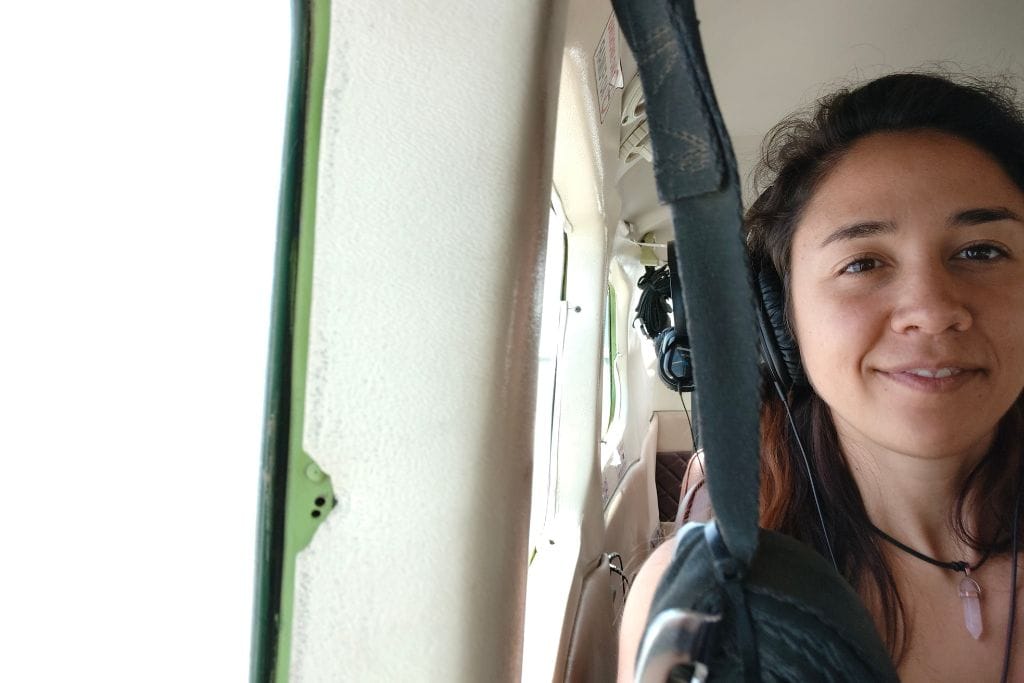

Following a spiritual awakening journey to Machu Picchu and the Rainbow mountain, I made my way back to Lima stopping at the mysterious Nazca Lines.
These ancient geoglyphs, etched into the arid desert of southern Peru, have captivated explorers, archaeologists, and spiritual seekers for centuries.
Despite extensive research, the true reason behind these vast and intricate designs continues to elude us.
This article is about the mystery of the Lines of Nazca, exploring their origins, theories, and the allure they hold for those seeking answers to one of Peru’s greatest puzzles.
Where are the Nazca Lines Located?
We all agree that the location of the Nazca lines is in Peru, South America, right? But what is the exact location of theses Nazca Lines in Peru?
The Nazca Lines are located in the arid Peruvian coastal areas, about 400 kilometers south of Lima, the capital city of Peru. This desert region, stretching over 80 kilometers between the towns of Nazca and Palpa, forms the canvas for these ancient geoglyphs.
The area’s consistently windless, stable, and dry climate has been crucial in preserving the Nazca Lines for over a thousand years, making them one of the most intriguing and visible archaeological sites from high above the earth’s surface.
Nazca Lines Location on Map
The Nazca Lines are located in the Nazca Desert, in southern Peru, specifically between the towns of Nazca and Palpa.
To get a visual understanding of the exact location of the Nazca Lines, below the map of Nazca Lines aka Lineas de Nazca.
History of the Nazca Lines

The Nazca Lines are a series of large, ancient geoglyphs located in the Nazca Desert of southern Peru.
These mysterious markings, which date back to between 500 BCE and 500 CE, were created by the Nazca culture, an ancient civilization known for its advances in agriculture, ceramics, and textiles.
The lines cover an area of nearly 1,000 square kilometers (386 square miles), and they are best known for their sheer size and intricate designs, which are only fully visible from the air.
What Do the Nazca Lines Represent?

The Nazca Lines are believed to represent a variety of things, though their exact purpose remains a mystery.
One widely accepted theory is that they were created for religious or ceremonial purposes.
Some scholars believe the lines were drawn as offerings to the gods, perhaps to invite rainfall or fertility, essential to the survival of the Nazca civilization in the arid desert environment.
The figures, such as animals and plants, could have been symbolic representations of the natural world, meant to honor deities that governed these elements.
Another theory posits that the Nazca Lines had an astronomical or calendrical function.
The precise alignments of some of the lines suggest they could have served as markers for important celestial events, such as solstices or equinoxes.
This idea is supported by the fact that certain lines and shapes seem to align with the position of the sun, moon, or stars at specific times of the year.
Some researchers speculate that the lines served as a kind of giant astronomical calendar, helping the Nazca people track time and seasonal changes.
How Were the Nazca Lines Made?
Imagine how crazy it would be to draw a line in the desert sand, and it would last forever. It might sound amazing, but let me explain: the vast desert ground isn’t just white sand; it’s iron.
Despite the complexity of their creation, the method employed was remarkably simple.
The ancient Nazca people uncovered the bright, light-colored earth beneath by removing the reddish-brown, iron oxide-coated pebbles that blanketed the Peruvian desert floor.
By strategically displacing stones to craft figures and lines, they produced these extensive artworks, which can be observed from significant distances or directly from above.
How Old are They and Why Were they Made?
The secrets of the lines of Nazca were created between 500 BCE to 500 CE, so how old are they? Over 2,000-year-old Nazca lines.
Beyond their spiritual significance, the Nazca lines might have also served astronomical or calendrical purposes, aligning with specific celestial events.
Who Made the Nazca Lines?
It was the ancient Nazca culture that made the Nazca lines. This is an ancient civilization known for its advanced art and pottery, crafted with these enigmatic geometric designs.
The exact reasons why the Nazca people created the lines remain uncertain, but it is believed that the geoglyphs were part of their religious or ceremonial practices.
The lines may have served as offerings to the gods, helped track celestial events, or played a role in ritualistic ceremonies tied to agriculture and fertility.
What is the Connection of Nazca Lines with Aliens?
Well, archeologists and scientists have yet to find any concrete evidence supporting the idea that the Nazca lines were created by ancient aliens.
Although, it could remain a possibility, as much as it couldn’t.
A long time ago we, humanity, had the capability of creating amazing things, much of which wisdom and creativity have faded over time. So, in my opinion, the lines of Nazca are human-made.
Maybe someone outside this place we call home visited and crafted these mysterious lines.
Who Discovered the Nazca Lines?
Technically, the lines of Nazca were never discovered because they were never abandoned.
While locals had been aware of the lines for centuries, it was not until Paul Kosok, an American historian, flew over them in the late 1930s that their significance was recognized internationally.
Later, in the late 1960s, Maria Reiche, a German archaeologist and mathematician, dedicated her life to studying and protecting these mysterious geoglyphs, earning them further attention.
How are the Nazca Lines Still There?

The arid, windless, and stable climate of the Nazca Desert is the primary reason these ancient artworks have survived for millennia.
The lack of rain, extreme weather, and minimal vegetation growth in this part of Peru have preserved the Nazca Lines from natural erosion.
So, why don’t the Nazca lines disappear? Well, their durability is a testament to both the ingenuity of their creators and the unique environmental conditions of their location.
Religious and Spiritual Significance
The Nazca Lines are believed to have significant religious and spiritual importance, particularly in the context of the ancient Nazca culture.
Here are some of the religious theories related to the Nazca Lines:
Offerings to the Gods
One prevailing theory holds that the Nazca Lines were created as offerings to the gods, particularly water deities.
The Nazca Desert is an arid region, and the creation of these geoglyphs may have been a way for the Nazca people to appeal to the gods for water and fertility.
The massive scale of the lines might have been meant to communicate with gods or spirits from above, possibly ensuring rain for agriculture or protection from natural disasters.
Ritual Pathways and Pilgrimages
Another religious theory suggests that the Nazca Lines functioned as ritual pathways for religious processions or pilgrimages.
The lines could have served as ceremonial routes during religious festivals, where priests or religious leaders walked them while performing sacred rites to connect with the divine.
Connection to the Underworld and Cosmic Energy
Some researchers have posited that the Nazca Lines were intended to represent or communicate with the underworld, a central concept in Andean spirituality.
The Nazca people, like other Andean cultures, believed in a cosmology that included the three realms: the upper world, the world of humans, and the underworld.
Certain animals and geometric shapes may have symbolized creatures or energies from these realms, helping to bridge the spiritual divide between the world of the living and the divine.
Sacred Sites and Temples
Some scholars believe that the Nazca Lines could have been part of a larger ceremonial or sacred landscape.
The area surrounding the lines includes numerous other geoglyphs, as well as temples and burial sites.
These lines might have led to specific sacred locations, creating a spiritual or ritual map that guided people toward important ceremonial sites.
NASA’s Involvement: Aerial Research and Discoveries
The mystery of the Nazca Lines was further deepened in the 1940s when aerial research revealed the full scale of these geoglyphs.
While scientists had known of the lines since the 1920s, it wasn’t until planes were used to survey the area that the full extent of the figures became apparent.
In 2018, a team of researchers from the University of Yamagata in Japan, using advanced satellite imagery, discovered new shapes and patterns, further suggesting that these lines were far more complex than originally believed.
In recent years, technological advancements have led to even more revelations about the Nazca Lines.
In 2019, a team of international researchers, including members from Germany’s Max Planck Institute, used ground-penetrating radar to reveal previously hidden lines and figures.
This has led to further debates about the role of these figures in ancient Nazca society.
Nazca Lines Photos
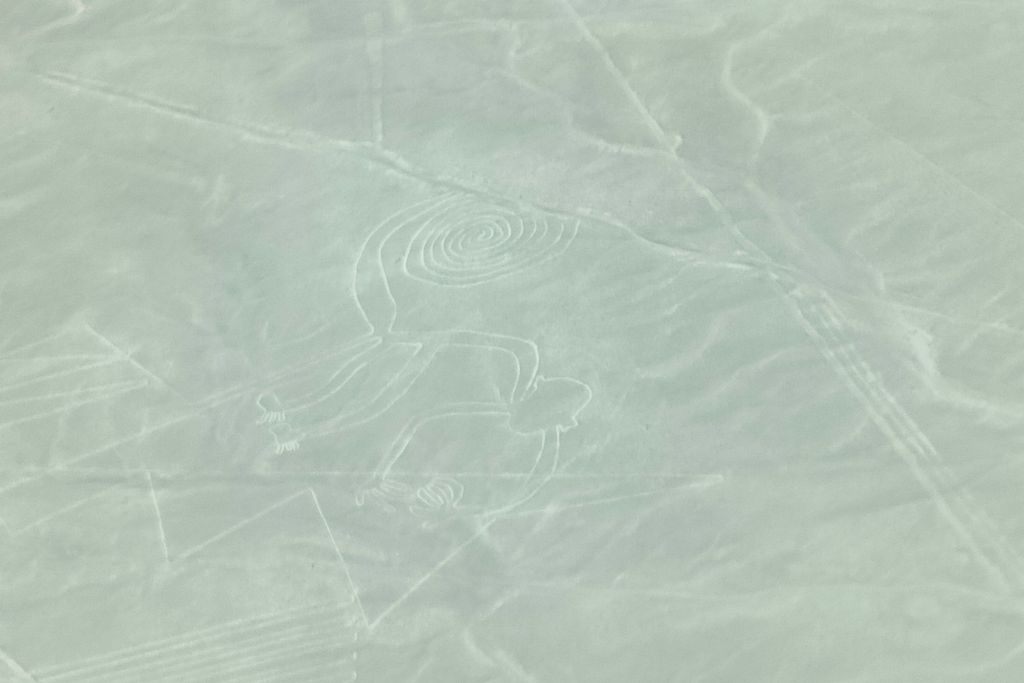
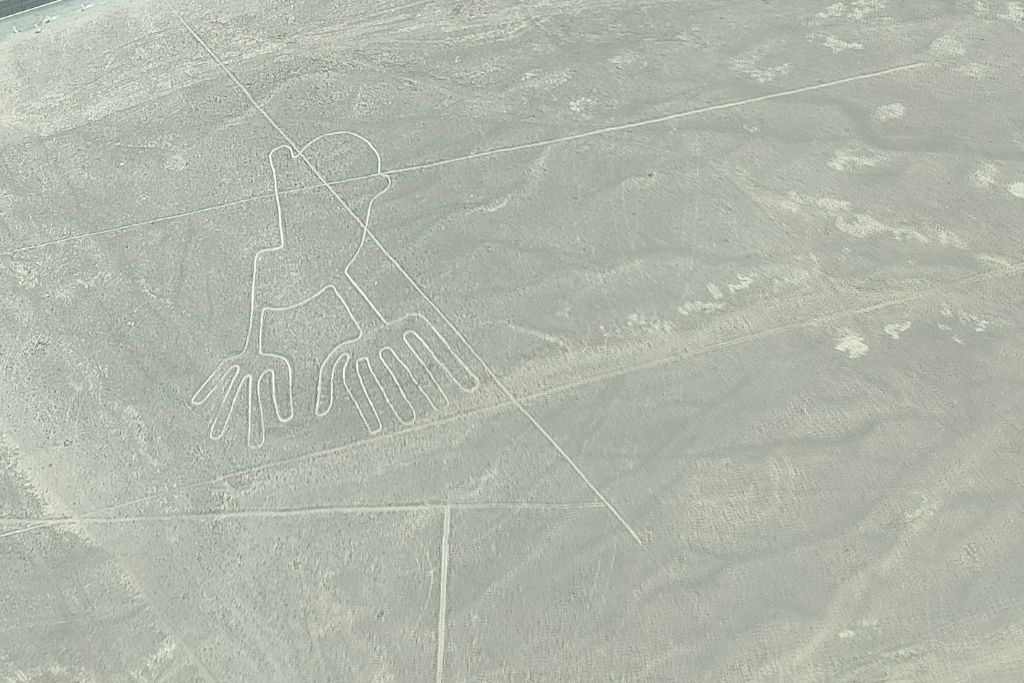
There are over 800 line figures, including 70 animal geoglyphs and plant designs, and 300 geometric figures.
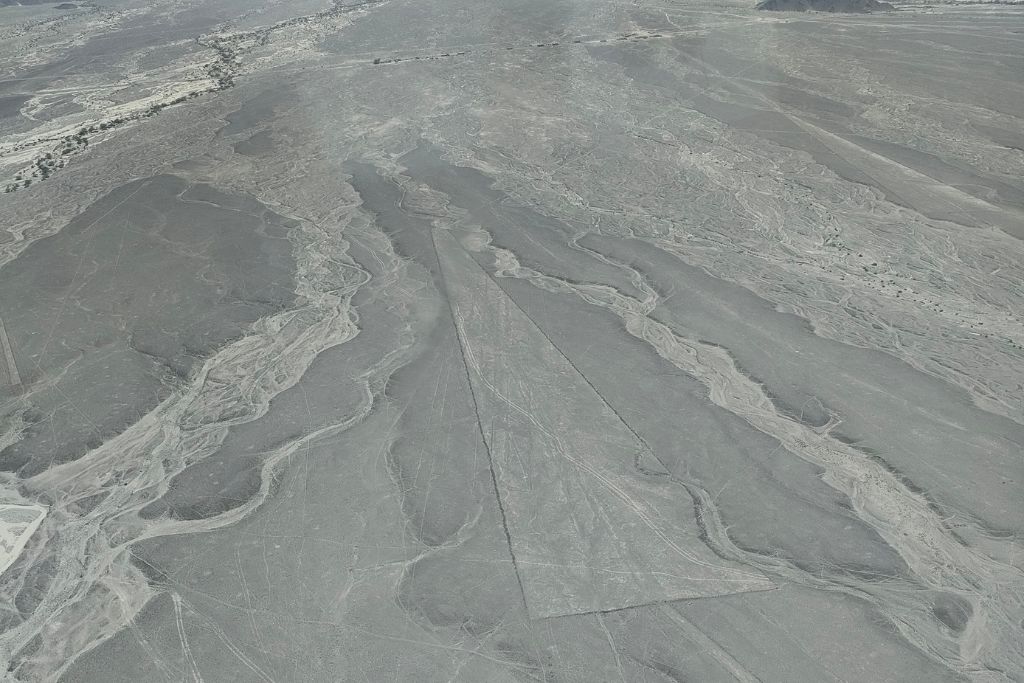
An aerial view of the Nazca Lines shows the intricate patterns and geometric shapes etched into the desert floor.
I am going to share the photos of the Nazca Lines I managed to capture during my flight tour.




How to See the Nazca Lines?
There are two options to see the Nazca Lines: one is to fly in a small plane, and the other is to see them from a desert-floor tower.
Flying Over the Nazca Lines

This option is not for the faint of heart, as you are flying over the Nazca Lines in a small aircraft, which means it would intensify the experience of air turbulence.
If you are wondering about the Nazca Lines flight cost, expect to pay around $80-$110 per Person.
Nazca Lines Tower
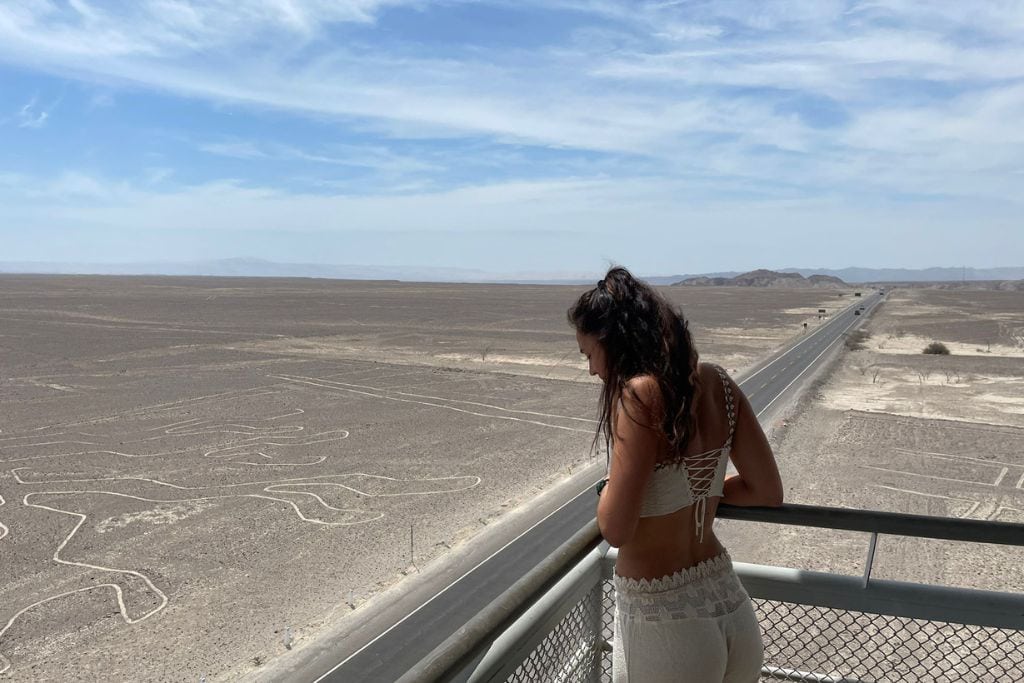
If you are not a fan of flying or are on a budget, fear not, because the Nazca Lines can be seen from the ground!
There is indeed a Naca Lines tower located nearby called the Mirador Tower (observation tower), where you can climb up and have a bird’s eye view of some of the famous figures like the hummingbird and the monkey.
How to Get to the Nazca Lines?
To get to the Nazca Lines, you should first begin your journey by heading to Nazca.
If you want to travel from Lima to Nazca Lines or from Huacachina to Nazca Lines, your best options include public transportation or renting a car.
Same for those coming from Cusco or Arequipa to the Nazca Lines.
IMPORTANT NOTE: The Nazca airport is used only for flying over the Nazca Lines. This means that Nazca is not reachable by plane.
Where to Stay?
An interesting fact about the Nazca Lines is that they’re located near the city of Nazca.
Therefore, I am including a brief section on Hoteles Nazca Peru.
Some recommended hotels Nazca Peru include Hotel Oro Viejo, Hostal Casa Andina Classic Nasca, and Hotel Majoro.
Personal Experience of Nazca Lines
I still vividly recall being half-asleep, after experiencing a spiritual awakening at Machu Picchu and then again at Rainbow Mountain.
After that, I headed to Nazca and went directly to the airport.
Thankfully, I did, as I would have regretted missing out on what came next.
Upon arrival, we started on a flight tour of this spiritual place. I immediately could sense the powerful energy of the area, as if it were a vortex.
The pilot provided us with an in-depth explanation of the history, pointing out significant figures that greatly enhanced our understanding.
I found the historical tour deeply enriching.
It gave me a deep insight into the significance of this place, leaving me forever thankful for the energy it imparted. And this experience served as the final push I needed to fully emerge from my spiritual journey: awakened and renewed.
FAQs: Why are the Lines of Nazca a Mistery of Peru?
How Big are the Nazca Lines?
Every line varies in size, with the largest one measuring about 370 meters aka 400 feet in length.
How Long are the Nazca Lines?
You might be surprised but the Nazca Lines could be long up to 30 miles aka 48 km.
How Deep are the Nazca Lines?
The Nazca Lines have a depth ranging from 10 to 15 centimeters, equivalent to approximately 4 to 6 inches.
How Many Nazca Lines are there?
As of now, over 800 lines have been discovered and mapped, with new ones still being uncovered.
Wrap-Up: Are the Nazca Lines Worth Seeing?
The straight lines of Nazca are worth seeing and experiencing.
This mysterious ensemble of geoglyphs offers a unique glimpse into the Nazca civilization’s artistry and possibly their worldview, still leaving us wondering about their true purpose.
Whether you decide to witness these incredible figures from the night sky or opt for a grounded view, the Nazca Lines promise an unforgettable experience that’s as enriching as it is awe-inspiring.
I hope you found this article very interesting and valuable.
For those of you interested to learn about more spiritual place, you can read about Arenal Volcano Area, The Sahara Desert, and The Seven Saints of Marrakech.
Sabiduri Planning Guide
🧘🏽♀️Where to find spiritual retreats around the World?
The good news is that they can be found in various locations, from secluded places in nature to bustling cities. Find your ideal retreat here!
🚑 Should you buy a travel insurance?
100% YES! — With basic coverage averaging just $50 for your stay, enjoy peace of mind with a plan from Travel SafetyWing, one of the biggest names in travel insurance.
🚗 Is it safe to rent a car around the World?
Yes — Renting a car is one of the best ways to see the country you find yourself in because public transportation cannot reach everywhere! I always rent with Discover Cars, which checks both international companies and local companies, so you get the best rates.
📴 Will my phone work abroad?
Maybe — It depends on your company, so check with your provider. If you don’t have a free service, buy a SIM Card once landed in the country.
🛌🏼 What’s the best way to book my accommodations?
For hotels, Booking is the best site, but for hostels, use Hostel World. If you’re considering Flats, don’t forget to also check Couchsurfing, which is free and you stay with locals.
🛩️ What’s the best site to buy flights?
For finding cheap flights, I recommend Kayak.
🛂 Do I need a visa for these destinations?
Likely Not — U.S., Canadian, and most European Passport holders don’t need a visa for most of destination around the World. BUT check here for more travel requirements. The majority of travelers will receive a 90-Day stamp Tourist Visa upon arrival.