When the Mountains Called Me Home: How Peru Re-Mapped My Inner Compass

For as long as I have sketched my future travels in the margins of my journal, Peru has remained high on my list.
My reasons have varied from intellectual curiosity to a deep connection with spirituality, combined with an overarching desire to immerse myself in the historical significance of the Andean culture of the Quechuan people.
I was drawn to the idea of exploring living Inca towns and standing inside stoneworks that remain wondrous achievements, surviving amidst the concrete jungles crafted by modern engineers. Peru’s traditions around ceremony and reciprocity have aligned with my ongoing inner work, fostering my intention to live a more purposeful life.
As the years passed and I continued to explore more of Central America, the Andes kept resurfacing in conversation. What follows is an account of the days I spent in Peru, detailing what captured my attention.
I offer this not as a checklist of sights to see, but as a lived experience demonstrating why certain destinations linger in our minds for years before we finally set foot on their soil. Once we do, these places often rearrange the way we perceive time, space, and the depth of our presence in today’s world.
Spiritual Adventure in Peru
Peru is much more that just Machu Picchu. In fact, I fall in love with this place because it is spiritually full of places, and it’s energy comes from another planet.
I have been to these sacred places in Peru, and each of them gifted me something extremely special. So, come along with my stories in Peru to find your next spiritual destination to be that is not just the touristic Machu Picchu!
Awakening in Cusco
After an 11-hour flight from Canada to Lima and a brief hop across the Andes, arriving in Cusco felt surreal.
The thin air reminded me that oxygen was scarce, making even simple tasks, like climbing stairs, feel challenging. This vulnerability heightened my awareness, illustrating that Peru is an all-encompassing adventure, a reconnection of body and mind.

Upon arrival, we were welcomed with coca tea at the JW Marriott El Convento hotel, nestled in the historical center of Cusco, with centuries-old cloisters that cushion modern comforts beneath carved cedar lintels.
As we navigated the narrow streets to find this hidden gem, I learned that many of Peru’s treasures lie beneath the surface, inviting continued curiosity and the desire for exploration. After a restful night and an introduction to local cuisine, we visited Qoricancha, one of the Incan empire’s most sacred sites.
Our knowledgeable Quechuan guide shared insights into the Ceque (siq’i) system, 41 directional lines radiating from Qoricancha that mark sacred waypoints, or huacas. These lines harmonized the empire’s practical and spiritual life, guiding agricultural practices and demonstrating loyalty to Cusco.
Running my hand along the temple’s warm stones, I understood our journey was not just a series of scenic stops but part of a network connecting body, community, and cosmos. As the coca leaves eased my altitude sickness, I felt the adventure truly begin.

Later that afternoon, a private shuttle wound us up the steep switchbacks to Saqsayhuamán, trading the bustle of the city for an open sweep of sandstone and sky. We arrived as the sun began its slow descent.
From the broad parade ground, I could see the lines of the whole city begin falling into shadow while structures around us basked in the day’s last light.
Our guide traced the outline of the puma, the shape embedded in Cusco’s master plan. The tail forms the two converging rivers, the body stretched out across the valley floor, and Saqsayhuamán itself as the animal’s massive stone head.
He reminded us that every stone here was believed to have been quarried, hauled, and set without iron tools or mortar.
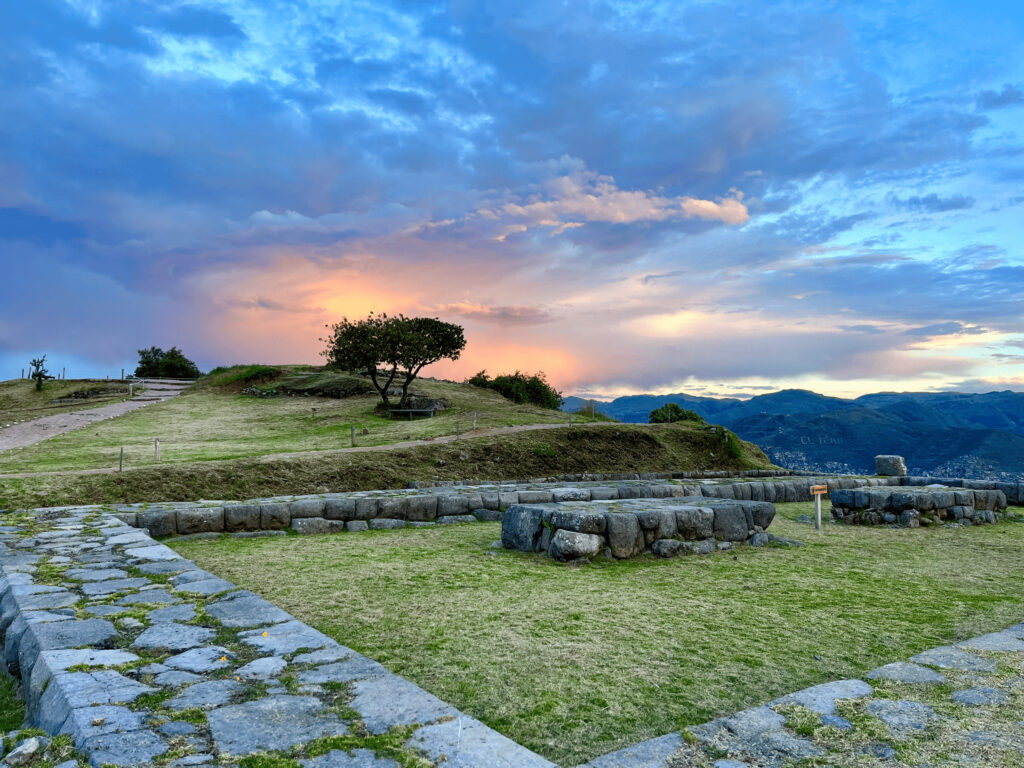
As sunset deepened the colors of the sandstone, the outline of the puma began to fade, leaving us with the impression that we were standing both inside an engineering masterpiece and a living myth. Despite the thin air, I realized I had never breathed so deeply.
READ MORE: Here is Your Spiritual Guide to Cusco Mysticism in Peru!
The Enchanting Sacred Valley
At first light, our shuttle left Cusco and followed the Urubamba River downstream. Our guide shared that the Incas called this corridor Willkamayu, meaning “the sacred river,” as they believed it mirrored the Milky Way.
As we approached Pisac, we admired the precise green terraces, each capturing a different micro-climate for crops like maize and quinoa. The air felt thicker and sweeter than in Cusco, reflecting the valley’s bounty.
We learned that these terraces were offerings to Pachamama, the Earth Mother, designed to channel water back toward her. Above us, the twin peaks of Pitusiray and Sawasiray stood as Apus, mountain spirits protecting the crops and farmers.
My understanding of the valley’s sacred nature deepened as I recognized it as a place where geography acts as a ritual, connecting heaven and earth.
That afternoon, we arrived at Taypikala Valle Sagrado, a former hacienda transformed into an adobe lodge facing Mount Pitusiray.
I was initially drawn outside by resident llamas but discovered a stone labyrinth that captivated me. Walking the labyrinth quieted my mind, leading me to the center as a tranquil punctuation mark rather than a destination, a reminder to keep moving and noticing.

The next morning, we headed to Ollantaytambo, following the river deeper into the ceque line connecting sky and soil. The town appeared suddenly, a grid of adobe houses built on ancient Inca foundations.
Climbing to the Templo del Sol left me breathless, offering breathtaking views of the town and surrounding peaks. Our guide pointed out the Ňusta’s Face on a nearby cliff, a natural formation recognized as both guardian and calendar.
As the solstice sun rises, it touches various points on the face, signaling farmers when to sow their high-altitude potatoes. I left in awe, feeling that the site had compressed a vast body of knowledge about Andean engineering, astronomy, and urban planning into one magnificent lesson.
LIVE THE SACRED VALLEY IN THE RIGHT WAY!
Machu Pichu
As we left our main luggage with the coach driver that morning, we took only small overnight bags to Machu Picchu. I knew we were catching a train, but I didn’t realize it would embody the essence of slow travel, honoring the land we crossed.
The train track, the valley’s only route to Machu Picchu, is graced by the blue-and-gold Inca Trail train. As it weaves past Urubamba, the dense, lush vegetation quickly reveals that we’ve entered the Andean cloud forest, with trail markers scattered along the way for those wishing to hike.
90 minutes later, the train arrived at our destination beside a mountain that rises so abruptly it seems detached from time. We landed in Aguas Calientes, a small town at the foot of Machu Picchu.
As we carried our overnight bags to El Mapi, where we would be spending the evening, we soon learnt of the rhythm of the town flanked on either side of a hissing river.
At this point, my curiosity had piqued. The experience that lay before me had been on my wishlist for decades. Keep moving, keep noticing. It was a resounding and unspoken energy we had all seemed to be carrying with us to this point.

Shortly after, I found myself on a green shuttle bus, switch-backing up the Hiram Bingham road so tight and steep it felt like ascending a ribbon pinned to sheer rock.
Rain met us at the entrance gate, whilst a little disappointing at first, I remembered the Andean teachings I had learnt along the way about living energy, that even mountains possess this, and I was quickly engulfed.
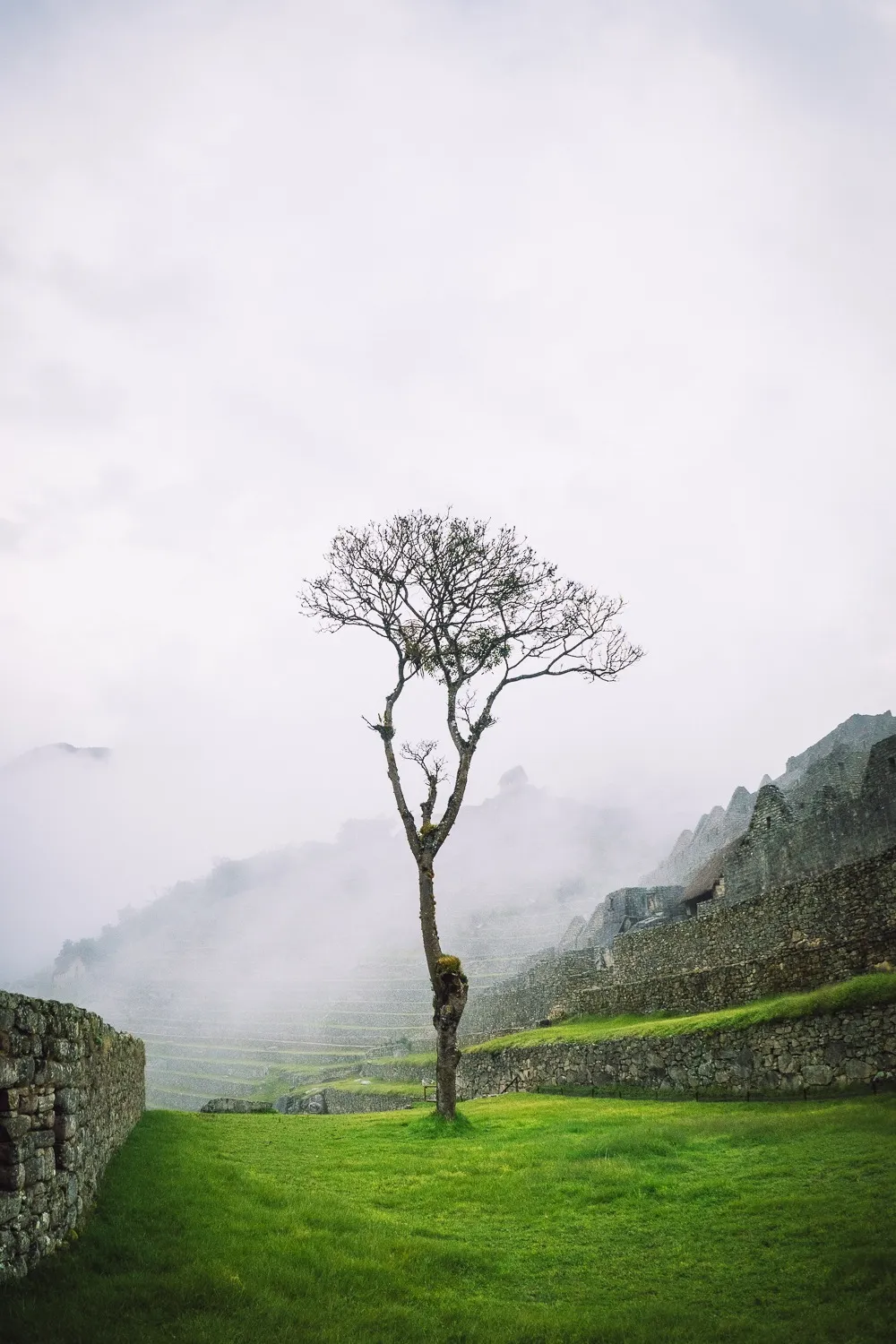
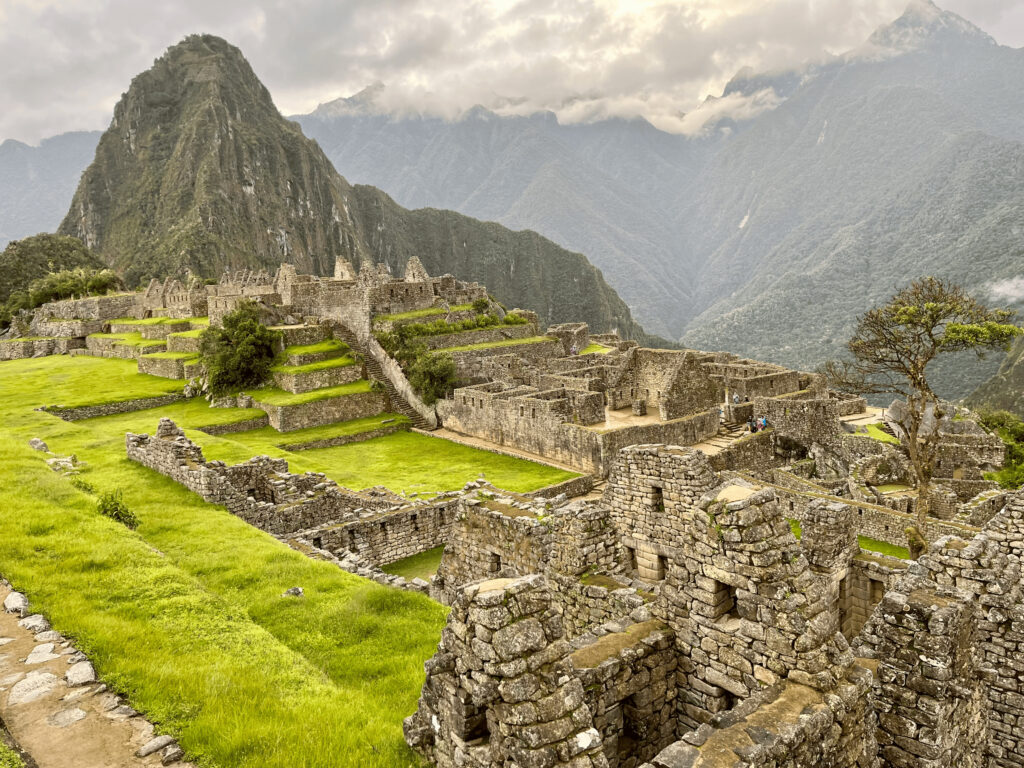
As we made our way up the path from the entrance, the clouds began to thin, unveiling Machu Picchu like a negative developing in a darkroom tray. Terraces stepped down in an improbable order, the peak of Huayna Picchu wearing its own cloud cap, with llamas grazing, routinely unbothered by the uniqueness of the ground that fed them.
Our guide led us past the Temple of the Three Windows to the quarry sector, where half-finished blocks lay abandoned, their chisel marks seeming like they were made just yesterday.
I ran my fingers over the rain-slick facet and felt the grain of time rather than its weight. As the mist drifted in and out, the guards had already begun signaling closing time.
I felt like I had been transported to another world. What had felt like only a few minutes of meandering through the pathways on Machu Picchu was, in fact, two hours of my life I could never describe in words.
We descended in near silence, each switchback returning a different angle of the mountain that minutes earlier had seemed to float.
Back in Aguas Calientes, we were met with the river hammering its waters against boulders as if almost insisting we remember whose passage had carved the entire valley. We were scheduled to depart by train the following morning, but that afternoon, the mountain stayed above and within me.
Decoding Machu Picchu Spiritual Energy (A Magic Experience)
Tinajani Valley
The morning after Machu Picchu, we boarded the earliest train from Aguas Calientes and rolled back down-valley to Ollantaytambo, where our private coach was already waiting. The drive through the lush Quechua hills gave way to the stark Aymara heights of the Puno Region.
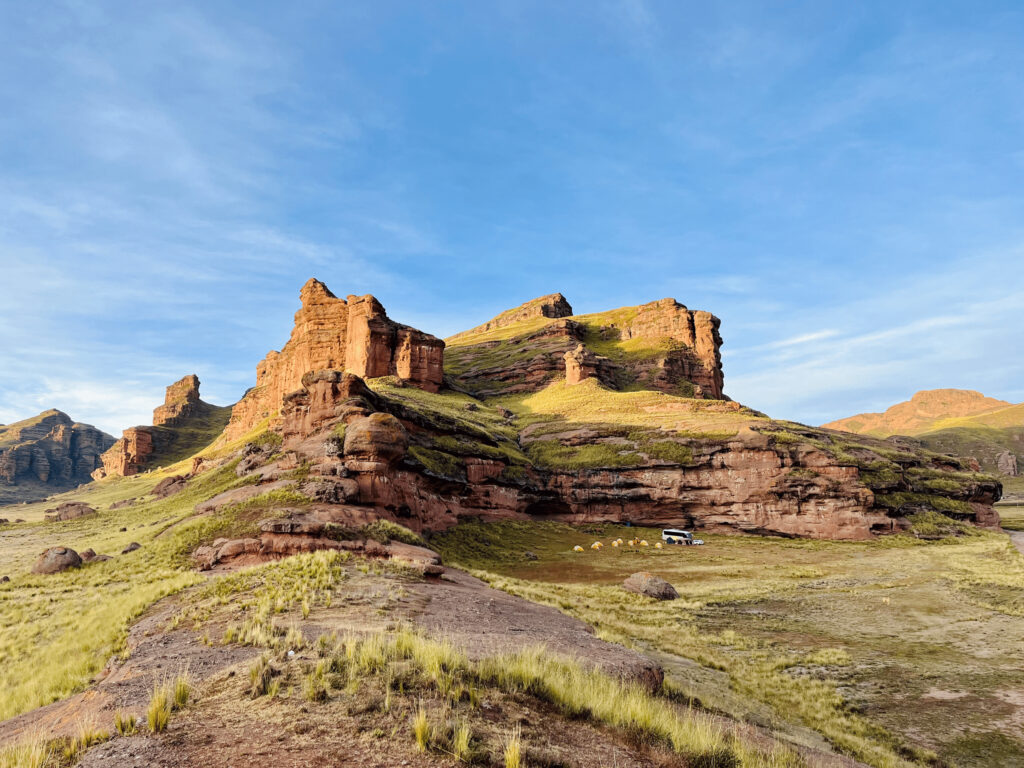
Six hours into the journey, sandstone pinnacles began rising upward from the plateau. We had finally reached the Tinajani Valley. The driver eased the coach onto a dirt spur that ended at a field already transformed into a private camp.
Yellow sleeping tents speckled the ground ahead, encapsulated by a rising mountain behind; this was where we would spend the next three days held by its magnitude.
Before sunset, we were guided across the open planes to wind-carved alcoves and fluted columns, turning the whole canyon into an open-air cathedral painted in rust and ochre.
He pointed out formations locals call the Monk and the Sentinel, shapes that catch the first light on solstice mornings. When the sun finally slipped behind the western rim, the pillars blushed from gold to ember and then surrendered to shadow.

As darkness settled, the temperature plunged below zero. We gathered around a crackling fire while our guide traced the Quechua constellations, each star-story mirrored by a corresponding spring or rock shelter somewhere in the canyon.
When I finally zipped into my tent to rest for the evening, the Milky Way burned so fiercely overhead that even the canvas glowed. Cold nipped my nose, but the stone beneath the earth still radiated the day’s stored heat.
Wrapped in blankets and a lingering echo of cedar smoke, I lay awake long enough to feel the canyon breathing, a slow exhale that seemed to synchronize with my own.
The next day unfolded at canyon tempo, the sunrise light painting the pillars rose, a late-morning hike to wind-hollowed caves where ancient shepherds hid from storms, and an afternoon gratitude circle for the expansiveness we had experienced.
Night returned with fiercer cold but an even louder sky, shooting stars catapulting across the sky in succession. At dawn, we packed our belongings and watched the red cathedral recede in the coach’s rear window until the landscape softened back into green.
By late afternoon, Cusco’s familiar stonework rose around us, and the Marriott’s oxygenated hush felt almost decadent after two nights of glacier air.
Over a closing and celebratory dinner with the group that evening, we raised one last toast, to the rivers that mirror constellations, to the mountains that measure breath, and to the Quechua principle of pacha, a reminder that every heartbeat belongs to the wider interconnectedness of land, sky, and one another.
Final Thoughts: Carrying the Andes Home
When I returned to Canada, I could feel the Andreas lingering in the fabric of my being. Mornings began with three slow breaths that recalled Cusco’s thin air, followed by a walk along a nearby park’s spiralling path, a reminder of the Taypikala labyrinth, meditation in motion.
These are only a few small gestures that I carried with me that kept pacha, the Andean belief that all things live in relation to one another.
Even though the mountains and rivers remained thousands of miles away, the rhythm they taught me still measured my days. Move deliberately, offer thanks, and let every action mirror the quiet constellations that guide it.
Author: Lynsey Logan
Lynsey is the voice behind Terra Selene, a slow-living journal devoted to travel, design, and daily routines that shape a more intentional way of living.
Over the past two decades, she has moved through seventy-three countries, collecting quiet details that have lingered long after the journeys ended. Informing her experience as a certified Fora travel advisor, she now curates wellness-infused journeys.
Sabiduri Planning Guide
🧘🏽♀️Where to find spiritual retreats around the World?
The good news is that they can be found in various locations, from secluded natural settings to bustling cities. Find your ideal retreat here!
🚑 Should you buy a travel insurance?
100% YES! — With basic coverage averaging just $50 for your stay, enjoy peace of mind with a plan from Travel SafetyWing, one of the biggest names in travel insurance.
🚗 Is it safe to rent a car around the World?
Yes — Renting a car is one of the best ways to see the country you find yourself in because public transportation cannot reach everywhere! I always rent with Discover Cars, which checks both international companies and local companies, so you get the best rates.
📴 Will my phone work abroad?
Maybe — It depends on your company, so check with your provider. If you don’t have a free service, buy a SIM Card once landed in the country.
🛌🏼 What’s the best way to book my accommodations?
For hotels, Booking is the best site, but for hostels, use Hostel World. If you’re considering Flats, don’t forget to also check Couchsurfing, which is free and you stay with locals.
🛩️ What’s the best site to buy flights?
For finding cheap flights, I recommend Kayak.
🛂 Do I need a visa for these destinations?
Likely Not — U.S., Canadian, and most European Passport holders don’t need a visa for most of destination around the World. BUT check here for more travel requirements. The majority of travelers will receive a 90-Day stamp Tourist Visa upon arrival.