
Xi’an Terracotta Warriors: History, Significance, and Travel Tips

Stepping into the vast pits housing the Terracotta Army is like traveling back over two thousand years to witness the formidable might of the Qin Dynasty.
This short but transformative period (221-206 BCE) saw the unification of a fractured land under the iron fist of Qin Shi Huang, China’s first emperor, who forged a centralized state with unprecedented power and ambition.
It’s difficult to truly grasp the scale of his vision until you stand before this entombed legion – thousands upon thousands of life-sized terracotta soldiers, archers, chariots, and horses, meticulously arranged in battle formations, an eternal guard for an emperor determined to extend his dominion even into the afterlife.
The sheer scale of the Terracotta Army is nothing short of breathtaking.
Each figure, with its unique facial features, intricate armor, and lifelike posture, speaks volumes about the advanced craftsmanship and immense resources commanded by the Qin Dynasty.
To walk among these ancient ranks, to gaze upon the faces of warriors frozen in time, evokes a profound sense of awe and wonder.
It’s a tangible connection to a pivotal era in human history, a powerful reminder of the ambition, artistry, and sheer human effort that went into creating this ancient treasure.
Experiencing the Terracotta Warriors is not just a sightseeing trip; it’s an immersive journey into the heart of an ancient empire, leaving a lasting mark on the soul.
What are the Terracotta Warriors?

Discovered by a farmer digging a well in 1974 near Xi’an, China, the Terracotta Warriors are a vast underground army of terracotta figures that turned the archaeological world upside down.
There are literally thousands of life-sized warriors, archers, chariots, and horses, that were found meticulously arranged in battle formations, guarding the tomb of China’s first emperor, Qin Shi Huang.
This incredible find, now known as the Terracotta Warriors, or the Terracotta Army, offers an unparalleled glimpse into the military might and funerary customs of ancient China over two millennia ago.
What’s even more astonishing is that each terracotta soldier is unique, with individualized facial features, hairstyles and attire, all rank specific, suggesting they were modeled after the emperor’s actual imperial guard.
Their creation involved an immense labor force and sophisticated craftsmanship, reflecting the power and resources of the Qin Dynasty.
Buried alongside them were a wealth of weaponry and other artifacts, intended to accompany the emperor into the afterlife.
The Terracotta Army stands as a silent, awe-inspiring testament to a pivotal period in Chinese history and continues to fascinate and educate visitors from around the globe.
A little background
I traveled to China several times a year for a handful of years back in my 20’s (and before COVID).
Like any single 20-something, I made the most of every work trip and usually spent 3-5 days exploring a new destination.
I’ve climbed the Great Wall at Badaling, explored the serene forest surrounding the Leshan Giant Buddha and strolled through the classical gardens of Suzhou.
My trip to Xi’an was a super quick weekend (Saturday morning to Sunday evening), so I only brought my purse. I packed my toothbrush, my passport, my wallet and my phone. What else did I really need?
China has very strict flight security. I once had nail polish in my bag that was confiscated, and they called in a supervisor who took my passport information to put a mark against me. Is this a 3 strikes and you’re out type of situation? I thankfully can’t answer that (yet).
Getting to Xi’an

The beds in China are significantly firmer than what you may be used to in the States. They also don’t use a flat sheet, but instead have duvet covers, which can be easily washed.
While I do like the cleanliness behind this (because US hotels don’t wash comforters…), I have a hard time sleeping.
In general, I’m not a great sleeper, then put me in a hard bed without a flat sheet to fold over and talk about restless nights. Add the jet-lag of a 14 hour time difference? Forget about it.
So naturally, I overslept the morning of my flight and rushed to pack my toothbrush, then biked as fast as I could to the metro. Getting to the airport and through security then finding my gate was all surprisingly quick.
I had some extra time, so I splurged on tea from a cafe in the airport (always always find yourself a good cup of tea in China!).
When flying into Xi’an, the view of the Qin Mountains from the flight is absolutely beautiful… But I couldn’t even take a photo because phones are strictly prohibited! Not even in airplane mode! As I said, flight security is incredibly strict in China.
The Xi’an airport does have international flights, but you’ll likely fly into China via Shanghai or Beijing. You can fly to Xi’an like I did, but you can also take a bullet train from many cities.
However, as you’ll learn from my experience, the best way to see the Warriors is probably through a tour company who arranges all your transportation and entry tickets.
Getting to the Warriors

One thing you should know about me is that I like to travel as close as possible to the way that locals would travel somewhere (translation: the hard way).
Making things hard on myself is not intentional, but hindsight tells me I must enjoy the thrill, or I’d take the suggested tourist route (like a guided tour).
Because of my affinity to travel like a local, even without knowing a lick of Chinese, I planned to take the bus from the airport to the Xi’an railway station, then another bus to see the Army.
I found the bus ticket counter in the airport just fine, but wow I had a heck of a time finding the actual bus stop. I followed the ‘Tourist Bus’ signs, figuring this would get me near the local buses, which took me past the taxi queue to a big parking lot full of buses that seemed to have no rhyme or reason to their parking spots.
After aimlessly wandering forever (okay, maybe only 10 minutes), I finally found my bus. The gal who seemed to be in charge of my bus yelled something in Chinese & everyone started lining up, so I followed suit.
I ended up in the 2nd line, then the 3-4 people in front of me got on, but when I gave her my ticket, she yelled at me and moved me to the remaining line. The seats weren’t assigned, and there isn’t a first class section, so I still have no idea why I was moved.
I did eventually get on the bus to the railway station, and the seat I chose was in the blinding sun, and (naturally) the only seat without curtains. The bus dropped us off in a back alley parking lot, at which point I was so thankful for the blinding sun and the daylight it provides.
I’d like to note, despite all the alleys I’ve had to walk down alone, I have never once felt unsafe in China. Between my jet-lagged 3 am wakeups to the sun setting at 5 pm, I’ve walked miles alone at night, and even then had no concerns.
However, you will still want to take normal precautions.
The drop-off point is quite the jaunt from one bus to the next, so I was also glad that Google maps semi-worked in Xi’an (if you’ve ever heard of the Great Firewall of China… make sure you have a VPN before you go).
When planning my route, I read that locals will be getting on the right bus, so it should be easy to tell which bus to get on. However, I also saw tons of locals on the wrong buses.
After walking around for a while and finally finding the bus area, I figured my best bet was the bus without someone yelling into a megaphone (I was right).
The former megaphone bus yellers also made their way to the Terracotta Army, where the rest of their megaphone army waited for the arrival of anyone who had ears. They are offering tours of not only the Warriors, but also Xi’an itself.
One gal (very aggressively, I might add) tapped me on the arm as I walked by to get my attention. Apparently she thought her megaphone wasn’t loud enough. I am sure their tours are great, but I wasn’t interested.
Terracotta Warrior Museum
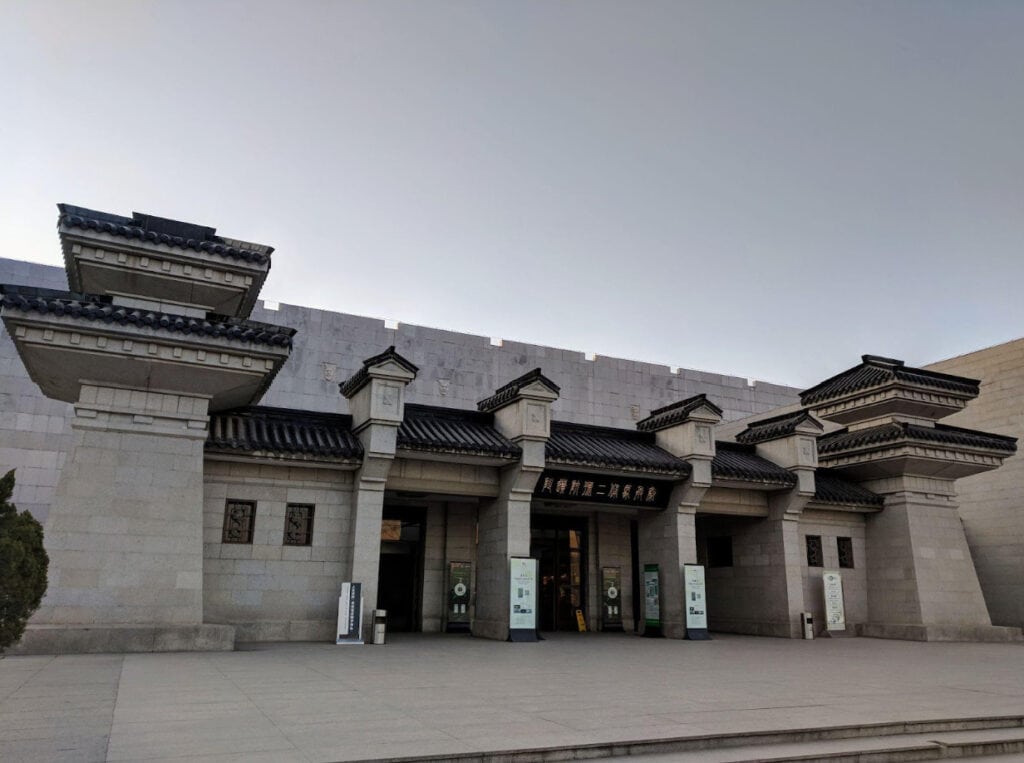
The bus dropped us off quite a ways from the entrance of the museum. There really aren’t any signs for the museum until you get closer. Street vendors yelled as I walked by to check out their goods.
If you’re still with me, you’ll notice I’ve talked a lot about the yelling, and yelling into megaphones. This is really just a cultural thing, as China is a loud country.
If you get the chance, I highly recommend reading “Lost on Planet China” by J. Maarten Troost. He has a great way of showing you the humor in the culture shock of all the noise. It will also make you really appreciate the serenity of a quiet moment.
When I finally reached the ticketing office for the museum, a guy asked me (in English) if I needed a guide, which I declined. I was warned about all the scams in Xi’an, so I was weary about buying a ticket.
Like I said before, I highly recommend arranging a guided tour beforehand to avoid any funny business.
My entry ticket cost 120 RMB. Like any attraction in China, there’s security where you’ll need to present your passport, then a long walk until you actually get in the park.

Pit 1 is the first area you’ll find, which is the largest, and where the whole army was originally found in the 70’s. The buildings rely mostly on natural light, so it wasn’t very bright inside.
You can also see the work stations of the archeologists, who have to piece together all the fragments of the warriors and horses. Some of the men are being held together by Seran wrap, which they don’t want you to take photos of (there are no photo signs posted).
Pit 2 has a small museum showing full soldiers in glass boxes that you can get close to and read about their ranks (miraculously in English!), which was very interesting.
Pit 2 is the smallest, as much of it is still being ‘uncovered.’ (They also don’t want you taking photos of the trash pile in Pit 2.)
Pit 3 was my favorite, by far. It was the least crowded and allowed you to get the closest views of the soldiers.
They also had posters detailing the different parts of the warriors and showing how they were painted when they were buried. Ancient man was seriously so impressive!
Heading back to Xi’an

I (unintentionally) left the museum a different way than I came in, which led me through a great little market with a surprising number of vendors.
Many were selling food, including white pomegranates, trinkets and furs (which I thought was super random). There was also an odd tomato-looking fruit that was solicited all around.
When I made it back to the railway station, it was dark, so the City Walls were lit up. It would’ve been a beautiful walk around.
After getting dropped off at my bus stop, I moseyed my way to my hotel which was amazing. Shortly after I checked out everything in my room, the maid stopped by to make sure everything was okay – it was perfect!
I don’t exactly know what it was about this hotel, but I slept the best I ever had in China.
Returning to Shanghai

Sunday morning, I planned to rent a bike to ride around the City Walls. However, I just wanted to stay in bed, so I didn’t have the time before my flight.
Instead, I went to get my bus ticket back to the airport before wandering around. The ticket office is near Long Hui Hotel, down a narrow alley with no English signage. It really doesn’t look legit, but turned out it was.
Again, I didn’t feel unsafe whatsoever walking down a back alley by myself.
Wandering through the area, I picked up a delicious stuffed flatbread filled with sweet potato. Soon after, I stumbled upon a charming public park, an ideal spot for people watching.
The park was a vibrant scene: elderly gentlemen practicing Tai Chi, not one but three distinct groups of dancers, and a couple playing badminton.
Adding to the park’s charm was a small lake offering paddle boat rentals and those inflatable wheels that allow you to walk on water like you’re a hamster.
Experience the wonders of Xi’an with our exclusive private day tour!
✅ Discover the legendary Terracotta Warriors,
✅ Delve into history at the Xi’an Museum,
✅ Admire the serene Small Wild Goose Pagoda,
✅ Walk atop the ancient City Wall,
✅ and immerse yourself in the vibrant culture of Muslim Street.
Book now for an unforgettable journey through time!
Final Thoughts: Is it worth visiting the Terracotta Army?
Even though my arrival in Xi’an was clouded by a less-than-ideal start to the day, standing before the silent ranks of the Terracotta Army completely washed those initial frustrations away.
The sheer scale and historical significance of the site are truly breathtaking, a tangible link to an emperor who lived over two millennia ago.
It’s funny, now that I reflect on my time there, the minor hiccups and annoyances of getting to the excavation site have completely faded from memory. It wasn’t until I reread my travel diary that those initial grumbles resurfaced.
What remains, vivid and clear, is the awe-inspiring sight of those thousands of unique figures, a testament to human ambition and artistry.
The Terracotta Army wasn’t just a tourist stop; it was a journey through time, a powerful reminder of the enduring legacy of history, and an experience that continues to resonate long after I’ve left Xi’an.
So, should you visit the Terracotta Army in Xi’an? My answer: absolutely, yes.

Author: Molly Clayton
Molly spent her 20’s traveling the world, mostly solo. Since her first trip abroad at 16, she’s had an endless list of destinations she wants to explore that only grows every time she checks one off. She loves planning the trip almost as much as actually traveling.
Now a small business owner and a mother, she loves the added challenge of traveling with her toddler and shows families that travel doesn’t stop when you have kids, it’s just a new beginning.
You can find her on social media, or follow along on her blog at HookedonHiatus.com.
Sabiduri Planning Guide
🧘🏽♀️Where to find spiritual retreats around the World?
The good news is that they can be found in various locations, from secluded places in nature to bustling cities. Find your ideal retreat here!
🚑 Should you buy a travel insurance?
100% YES! — With basic coverage averaging just $50 for your stay, enjoy peace of mind with a plan from Travel SafetyWing, one of the biggest names in travel insurance.
🚗 Is it safe to rent a car around the World?
Yes — Renting a car is one of the best ways to see the country you find yourself in because public transportation cannot reach everywhere! I always rent with Discover Cars, which checks both international companies and local companies, so you get the best rates.
📴 Will my phone work abroad?
Maybe — It depends on your company, so check with your provider. If you don’t have a free service, buy a SIM Card once landed in the country.
🛌🏼 What’s the best way to book my accommodations?
For hotels, Booking is the best site, but for hostels, use Hostel World. If you’re considering Flats, don’t forget to also check Couchsurfing, which is free and you stay with locals.
🛩️ What’s the best site to buy flights?
For finding cheap flights, I recommend Kayak.
🛂 Do I need a visa for these destinations?
Likely Not — U.S., Canadian, and most European Passport holders don’t need a visa for most of destination around the World. BUT check here for more travel requirements. The majority of travelers will receive a 90-Day stamp Tourist Visa upon arrival.