How to Visit Salar de Uyuni in 2026: My Lifetime Experience!


Have you been looking on how to visit Salar de Uyuni? We’re Divinely Guided!
Visiting Salar de Uyuni, the world’s largest salt flat located in Bolivia, has always been high on our travel wish list. However, since we haven’t had the privilege of experiencing its surreal beauty firsthand, we turned to someone who has.
James, an avid traveler with a knack for exploring some of the planet’s most extraordinary landscapes, kindly agreed to share his insights.
With a wealth of travel experiences under his belt and an impressive portfolio that speaks volumes about his expertise and authority on the subject, James brings a level of trustworthiness and personal insight into what makes Salar de Uyuni a must-visit destination.
Through his eyes, we invite you to embark on a journey to this mesmerizing place, where nature defies expectations and offers sights beyond imagination.
How to Visit Salar de Uyuni
When I first started backpacking and exploring this world, there was a place that held the top spot on my “Must See” list. Salar de Uyuni Salt Flats. A massive salt flat located in Southwestern Bolivia.
For years I looked up pictures, checked out routes, and daydreamed about one day stepping foot on the natural world’s largest mirror.
Finally, in 2018, after weeks of traveling throughout South America already, the day came and I couldn’t have been more thrilled!
After finding the right tour guide (which turned into a hassle, more on this later) a group of us set out to spend the long day exploring this natural wonder.
We all hopped in an SUV and headed out to, what ended up being, one of the single best experiences of my life, and I don’t say that lightly.
The feeling of stepping out and looking around, seeing nothing but a reflection of the earth in every single direction, is hard to put into words. It was like being a kid in an endless candy store, but the store’s candy was infinitely sweeter than any lollipop.
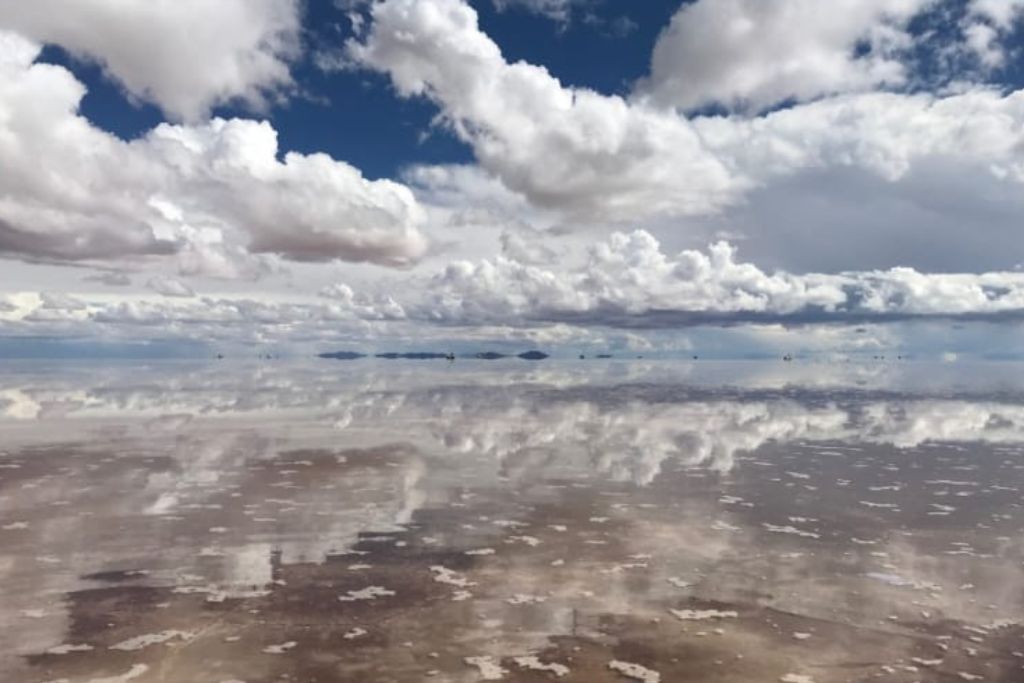
You see, for part of the year a thin layer of water forms over the salt, covering about 4,000 square miles (6,400 km) of near perfectly flat terrain. There are some mountain islands here and there, but for the most part, it feels like you’re on the edge of the world.
During the dry season, the ground turns intensely white, uncovering a crystalline layer of hexagonal patches that stretch as far as the eye can see.
If you’ve ever seen the movie “Star Wars: The Last Jedi” you’ll recognize the flats subbing in as the planet Crait during the final battle.
It’s a photographer and explorer’s dream. If you’re reading this, you probably agree and would love to know more about experiencing this unreal locale. Great! I got you!
In this article, I’ll tell you what happened to me and give some tips at the end so you can avoid some of the problems I faced. Keep them in mind if you eventually decide to go.
An overview of what’s to come:
- Brief history of Salar de Uyuni Salt Flats
- My personal experience
- Tips for planning a trip to Salar de Uyuni tour
- Final Thoughts
Hopefully, by the end, you’ll be itching to go! Ok, enough fluff. Let’s get going, shall we?
Brief History of Salar de Uyuni

To put it bluntly, Salar de Uyuni is a massive dried-up lake. About 30,000 – 40,000 years ago, Lake Minchin as it’s called now, started evaporating, creating smaller lakes and mini deserts.
Over time, smaller and smaller lakes formed, eventually drying the area up completely, resulting in one of the top natural wonders of the entire world. (Not quite making the famous top 7, but close)
What I find interesting is where the salt came from. Scientists believe the prehistoric lakes themselves leached all of the salt out of the surrounding mountains, but as you can clearly see, didn’t vanish as the lakes did.
Guess how much salt was left over? If you guessed 11 billion metric tonnes, you win! I can’t fathom how much that is, but I’m sure we’re not going to run out anytime soon.

Skip ahead to about the 1500s when the first recorded mining operations began in the Colchani Mine which still operates today, producing about 5,000 kg of salt daily.
The ancient villages would use the salt in trade, sometimes venturing for 100s of square kilometers for coca or maize.
Many Indigenous cultures have lived and occupied the area throughout history. Including the Tiwanaku, Inca, and Uru-Chipayas civilizations. Most recently the Aymara people call it home. Incredible!
That brings us to the modern era. Besides being a huge tourist destination, Salar de Uyuni wears many hats. For instance, researchers bounce lasers off of it from satellites to calibrate their distances and altimeters.
The ground is so incredibly flat, it’s a prime spot for measurement! It’s reported that there’s only 1 meter of vertical variance within the entire area. Pretty astonishing!
Also, 50% – 70% of the world’s lithium is contained there, which is a big component in electronics and batteries we all rely on, and a huge resource for the Bolivian economy.
The flats are great for animals too, as local wildlife such as foxes and pink flamingos use it as a haven. The list goes on and on.
I could chat about the importance of the flats all day but let’s get to the point of this article. What you should expect when arriving in Uyuni.
My Personal Experience at Salar de Uyuni
Like most travelers through South America, I arrived in Uyuni by bus from La Paz. It was an overnight trip that took somewhere around 9 or 10 hours. It was full of fellow sightseeing tourists just itching to get to the Salar.
Note: There’s an airport in Uyuni (La Joya Andina) but it’s incredibly expensive to fly into. Few do it.
I clearly remember how the town of Uyuni seemed so desolate. The streets were fairly empty, there was nearly zero plant life, and everything was colored with a shade of beige or brown.
It felt like I stepped back into the old west, ready for an old-fashioned showdown.

After getting off the overnight bus I quickly found the best place to rest my gear and started searching for a multi-day tours of the Bolivia salt flats.
I made a huge rookie mistake by not doing any kind of research on which company to use before arriving and paid a small price for it that I’ll go over later on. Not a big deal now, but certainly a life lesson that I’ve never forgotten.
While checking rates and weighing options, I recognized a group of fellow travelers that I’d seen at different times along my backpacking journey and said hello. It was a group from Germany who were headed in the same direction as I was.
I asked if they could use one more and they said “Sure!” so I joined in.
They already had a tour guide lined up so I didn’t ask any questions and followed along. Not very smart, but I didn’t care at the time. I was just happy to have found something that works.
And so we were off! We packed all our stuff into a rickety SUV, a visual clue that foreshadowed the delay of adventure later on, and hit the road.
A Metal Graveyard
Our first stop was the famous “Cementerio de Trenes” better known in English as the train cemetery, located right outside of the town limits.

Here we found, as you might expect, century-old trains left to rot after the local mining collapse of the 1940s.
The impact of the neighboring salt deposit was clear as every single piece of air-exposed metal was completely coated with a layer of reddish-brown rust. The only other colors found were from the decorations of aspiring graffiti artists.
After an hour of exploring the trains, we headed to the main event, the Salar de Uyuni! The excitement in the air could be cut with a knife.
However, before we got to the flats, we made a brief stop in the mining town of Colchani where the group window-shopped, took some pics of sculptures made of salt inside their local salt museum, and had a quick bite of the local fair.
All in all, about a 30-minute break.
The Fantasy Land
We climbed back into the SUV and could barely contain our enthusiasm. Everybody had a humungous smile on their face as the salt flat came into view.
We slowly drove toward the natural phenomenon, creeping over a 2-inch layer of water, and finally made it to the dreamy landscape. The energy was electric!
The SUV parked, we got out and started marveling at what we saw. An endless mirror that covered the entire world. It was incredible!
The horizon appeared to melt into the distance as the clear skies and earth merged into one, reflecting each other perfectly. It was like Mother Earth took a giant paintbrush and designed a fantasy world.

We were stunned. We thought we knew what to expect, but we had no clue.
After a while, someone eventually spoke words I’ll never forget. “This is the most beautiful thing I’ve ever seen.” All of our heads nodded in agreement.
“Yes, it is,” a few of us said as we kept our eyes glued to the astounding natural beauty that enveloped us. “Yes, it is.”.
Everybody immediately started taking picture after picture, video after video. We had fun with it. Some took funky perspective photos while I took “flying” selfies! It was a blast! After what only seemed like minutes, but lasted well over an hour, we sat down and had a brisk lunch.

The food was ok, nothing memorable, but we didn’t care. We were just happy to be where we were. We quickly ate and got back to enjoying the scenery.
After snapping photos for another hour and soaking up every second of it, we gathered in the SUV and headed to the last attraction of the day. The Dakar Monument.
Unexpected Bonuses
Built in 2014, this structure represents the Dakar Rally and is made of entirely, you guessed it, salt.
There were rows of flags nearby that represented the countries that raced and a mini community selling all types of trinkets, snacks, and drinks. A few of us grabbed a beer and enjoyed the moment. What a day!

Now came the dreaded time of leaving. We sadly piled back into the vehicle and drove away. I was perfectly fine with finishing up, but my fellow passengers wanted more.
As the sun set, we begged and pleaded with the driver to stop so we could jump out and grab some final shots of the glorious sunset we were witnessing.
There was a heavy storm rolling in so he was hesitant at first but ultimately stopped. We hurriedly exited and took our final pics and videos. The lighting was incredible. The sun looked like a giant brilliant eyeball and the clouds its lazy eyelids.

Sadly, the intense lightning started cracking down harder and closer to us so our driver had enough. He forced us to pack up and we got out of there as the sun made its final goodbye.
Issues Arise
Later that night we had dinner that was provided by the tour company and stayed in some huts made of stone tree and dirt. We chatted about the day and hit the hay. The next early morning we all packed up and looked forward to our long drive to Chilé.
That’s when things took a downturn. As we started our journey, the SUV started shaking, lightly at first, then more and more.
Our driver didn’t speak any English and none of us spoke Spanish, (another bad decision) so as we made our concerns known, he ignored us.
He kept waving his hand and saying something that I could only interpret as “Don’t worry” or “It’s not a big deal.” Something to that effect. We let it go at first, hoping the shaking was due to the terrain or some other trivial thing.
The issue persisted. We got to a paved road and our speed increased. The rumbling got worse. Enough was enough. All the German guys became fed up and practically screamed at our driver to stop. At last, he relented and we pulled over.

Everybody exited the vehicle and looked around. It took a minute, but we found the problem. One of the tires was detaching from the rim! That’s not good. The driver however was unphased.
He attempted to brush it off as “normal” and wanted to continue down the road. We refused. Nobody would get back into the car and one of the German fellows kept saying the word “peligroso, peligroso” which means dangerous in Spanish.
After an hour or so of this, we got the driver to drive us back to Uyuni. He wasn’t happy, but what could he do? Everybody got in and not a word was spoken on our return trip to the small town.
Once we got there, we explained the situation to one of the workers who did speak English and got a partial refund for the remainder of the voyage. We found another company and resumed our journey, eventually getting to Chilé the next day.
What an ordeal!
I can honestly say that at no point was I overly worried, but I can’t say the same for my travel mates. If it wasn’t for them, who knows what would have happened?
We could have broken down in the middle of the salt desert, stranded without help in sight. I guess I have to thank them for their perseverance because, without them, we could have been in a world of hurt.
All in all, my time in Bolivia was a great experience. I’ll remember it for the rest of my life.
I could easily look back and say, “Yes, I should have done a few things differently.” but I feel your experiences shape who you are and I’m happy with who I’ve become.
Live and learn!
Tips for Planning a Trip to Salar de Uyuni
That doesn’t mean you should do as I did though. As you can imagine, there are a few things I highly recommend you do so you won’t go through what I went through.
If you follow these simple guidelines, you should have a fabulous time in and around Salar de Uyuni and be A-OK.
#1. Know Before You Go
When creating your itinerary, look into the different options available for experiencing Salar de Uyuni.
There are two main types of tours. Single-day road trip that start and end in the town itself or three-day tour/4-day tours that start in Uyuni and end in San Pedro de Atacama desert. If you’re coming from Chilé, it’s in reverse.
If you want to rent a vehicle, there are limited options in Uyuni itself, so you’ll need to rent one from either the town of Sucre or La Paz.
#2. Research Your Bolivian Salt Flats Tour
Unsurprisingly, my next piece of advice is to read up on the different tour companies that cater to Salar de Uyuni. There are a bunch available, some better than others, but don’t leave it to the last second to pick one.
Read as many good reviews as you can and take plenty of time with it. Don’t be afraid to pay a little extra for your peace of mind. It’s well worth it!
Sites like Tripadvisor and Viator are great online resources where you can learn a lot about who’s the best and competitive tour prices.
#3. Book in Advance
If you can, book all of your stays and tour guides well in advance so you don’t run into availability issues, especially if you’re going during the busy tourist season of January-March.
When my group finally got to San Pedro de Atacama, we had a hell of a time finding available lodging since it was during the busiest time of year. We eventually found something, but it wasn’t great. Take my word for it.
#4. Best Time of the Year
There are two seasons for Salar de Uyuni. The wet and dry. Each provides its spin on the experience, but since I was memorized with my adventure, I highly recommend going during the wet season which lasts from November to March.
The dry from April to October. I’ve heard and read that the best chance at seeing both, the mirror effect and the dry white floor, is in April.
You’re hitting the tail end of the rainy season so there might be days of accumulated water that dry up after a day or two. If you have a loose schedule, shoot for this, but there are no guarantees.
Final Thoughts: Is Salar de Uyuni Worth It?
Visiting Salar de Uyuni is truly an experience of a lifetime. There’s no better way to say it. Even while writing this article, I kept thinking about how these words don’t do any justice to what I witnessed.
It’s like describing color to a blind person, truly impossible to convey. You have to go for yourself.
It’s the perfect addition to any bucket list. As long as you do some research ahead of time and don’t “wing it” like I did, you’ll set yourself up for success.
Follow safe traveling guidelines and have fun! The world is full of opportunities and it’s up to you to go after them.
Be safe and happy traveling!

Author: James Ryan
James Ryan is a seasoned hiker and adventurer who loves to travel and experience new things. An extrovert and creative at heart, James is most definitely a “People Person”. He started his blog in the hopes of sharing his knowledge and expertise. Look him up and give him a shout today!
Sabiduri Planning Guide
🧘🏽♀️Where to find spiritual retreats around the World?
The good news is that they can be found in various locations, from secluded places in nature to bustling cities. Find your ideal retreat here!
🚑 Should you buy a travel insurance?
100% YES! — With basic coverage averaging just $50 for your stay, enjoy peace of mind with a plan from Travel SafetyWing, one of the biggest names in travel insurance.
🚗 Is it safe to rent a car around the World?
Yes — Renting a car is one of the best ways to see the country you find yourself in because public transportation cannot reach everywhere! I always rent with Discover Cars, which checks both international companies and local companies, so you get the best rates.
📴 Will my phone work abroad?
Maybe — It depends on your company, so check with your provider. If you don’t have a free service, buy a SIM Card once landed in the country.
🛌🏼 What’s the best way to book my accommodations?
For hotels, Booking is the best site, but for hostels, use Hostel World. If you’re considering Flats, don’t forget to also check Couchsurfing, which is free and you stay with locals.
🛩️ What’s the best site to buy flights?
For finding cheap flights, I recommend Kayak.
🛂 Do I need a visa for these destinations?
Likely Not — U.S., Canadian, and most European Passport holders don’t need a visa for most of destination around the World. BUT check here for more travel requirements. The majority of travelers will receive a 90-Day stamp Tourist Visa upon arrival.